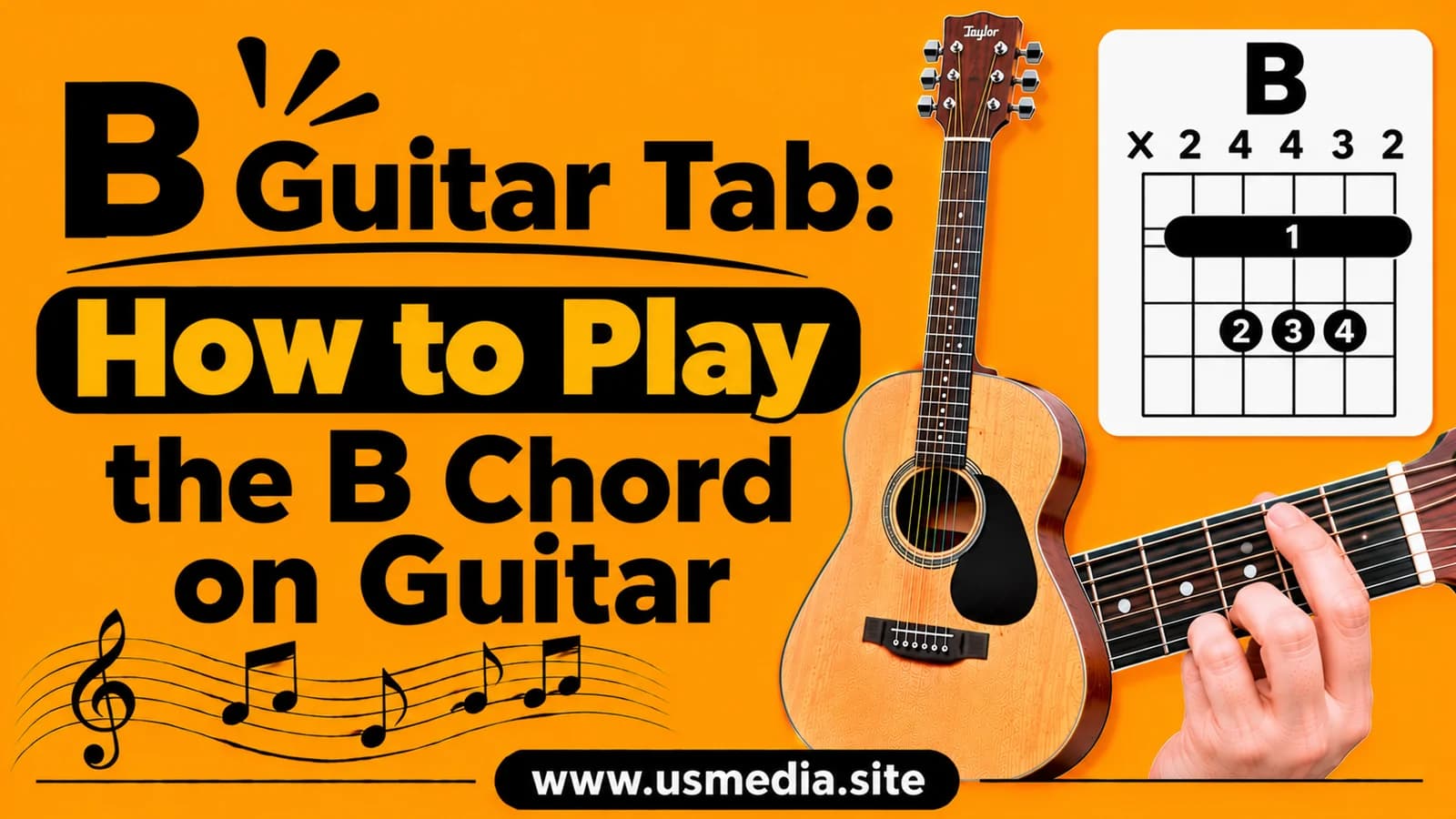
If a guitar tab shows a B chord, start with the full shape: x–2–4–4–4–2. The low E string stays out, and the other five strings form B major. If the barre feels awkward, we’ll walk through two smaller voicings that keep the same chord tones but use fewer strings.
What notes make a B major chord?
B major is a triad made from B, D♯, and F♯. B is the root, D♯ is the major third, and F♯ is the perfect fifth. The formula is 1–3–5. Guitar shapes may repeat these notes in different octaves, so a five-string B chord still contains only three distinct chord tones.
Read the full B chord in guitar tab
In standard tuning, tab has six horizontal lines, one for each string. The top line represents the high E string, and the bottom line represents the low E string. Numbers show frets. A 0 means play an open string. An x at the start of a chord pattern means leave that string out or mute it.
Here is a common five-string B major barre chord:
e|--2--|  high E string
B|--4--|
G|--4--|
D|--4--|
A|--2--|
E|--x--|  low E string
The same shape, written from the sixth string to the first, is x–2–4–4–4–2. The low E string is...