
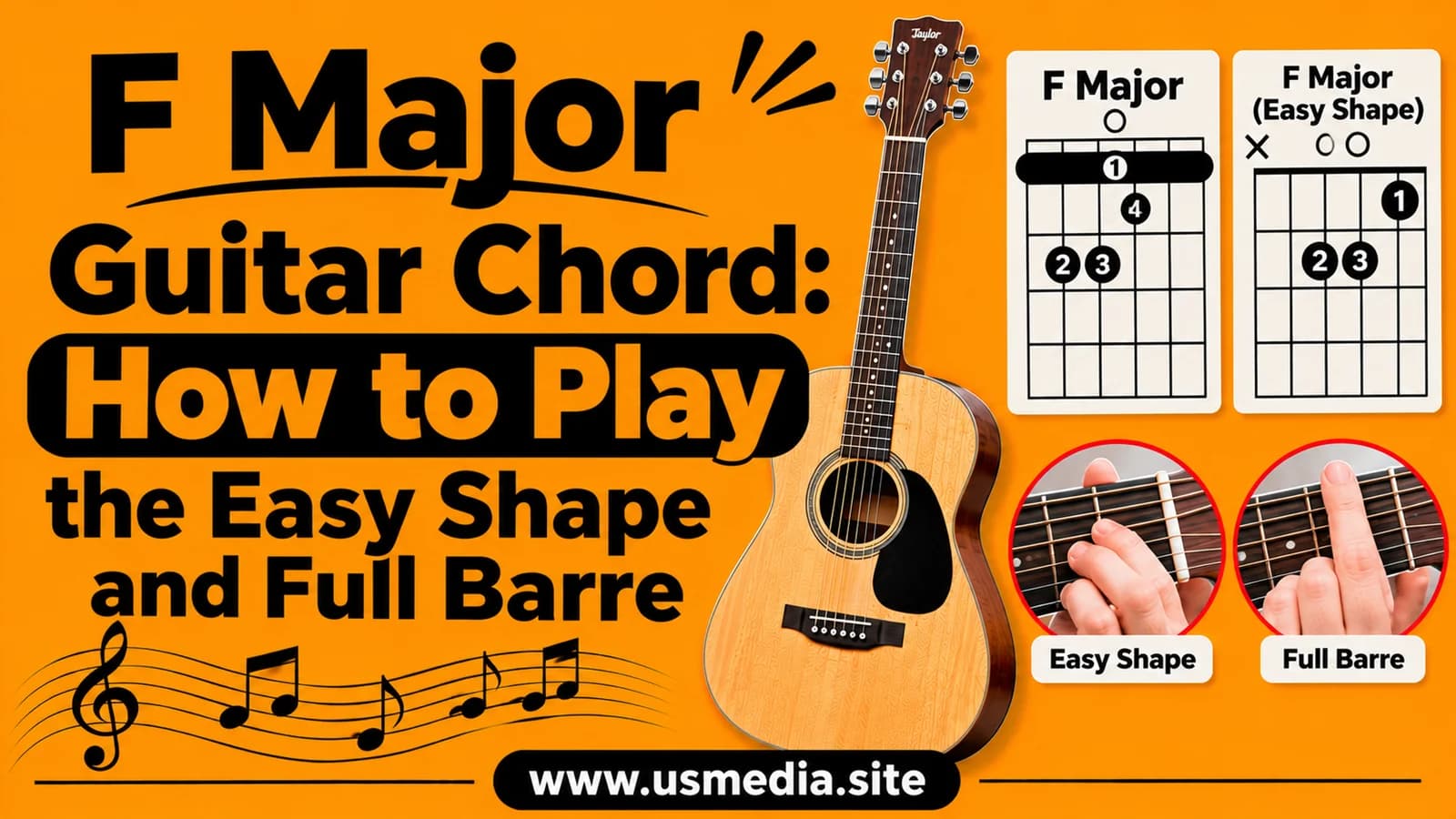
The F major chord can feel like a sudden jump in difficulty because its familiar first-position shape often uses a barre. You do not have to start with all six strings, though. A four-string version gives you a practical way to play F major while you build coordination; the full F barre can come later. At usmedia.site, we’ll show both shapes, explain what each one asks of your fretting hand, and help you check the notes without forcing your fingers.
F major chord at a glance
F major is built from three notes: F, A, and C. The notes may repeat in different octaves in a guitar voicing. In standard tuning, these are two common first-position shapes:
Four-string shape: xx3211
  Strings 6 to 1:    x x 3 2 1 1

  Full barre shape:  133211
  Strings 6 to 1:    1 3 3 2 1 1
The numbers run from the thickest string (string 6) to the thinnest (string 1). A number tells you the fret to press. x means do not play that string. The four-string shape uses only the D, G, B, and high E strings. The full barre shape uses all six strings.
How to play the four-string F chord
The xx3211 shape is a useful starting point if a full barre is not comfortable yet. It leaves out the two thickest strings...