
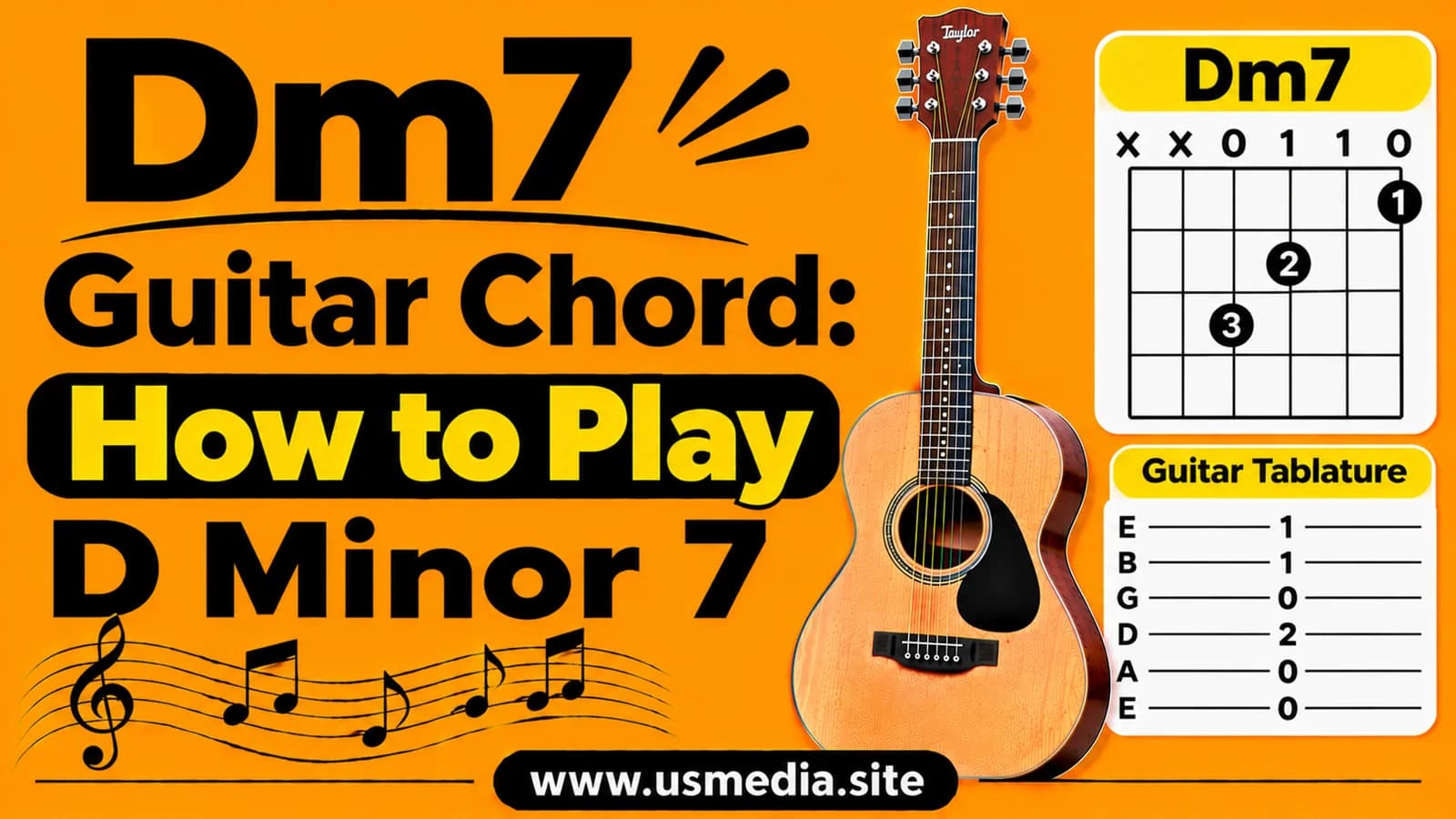
If a chord chart tells you to play Dm7, the open shape may look easy until you try to make both first-fret notes ring while keeping the two bass strings out. We’ll break down the open fingering, show a movable barre option, and give you a string-by-string check so you can hear whether every note is clear. That’s how we approach practical chord lessons on usmedia.site: learn the grip, understand the notes, and put the chord into music.
What notes make up Dm7?
D minor 7, written Dm7, contains D, F, A, and C. These are the root, minor third, perfect fifth, and minor seventh, written as 1–♭3–5–♭7. The D minor triad is D–F–A; adding C creates Dm7.
The chord symbol matters. Dm7 is not the same as D7 or Dmaj7. D7 contains D–F♯–A–C, while Dmaj7 contains D–F♯–A–C♯. In Dm7, F is a minor third and C is a minor seventh. These differences can help you catch a wrong note when a chord sounds unlike the chart.
Change from Dm to Dm7 by moving one note
A common open D minor chord is xx0231. To turn it into open Dm7, change the B string from fret 3 to fret 1: xx0231 becomes xx0211. That changes the B-string note from D to C,...