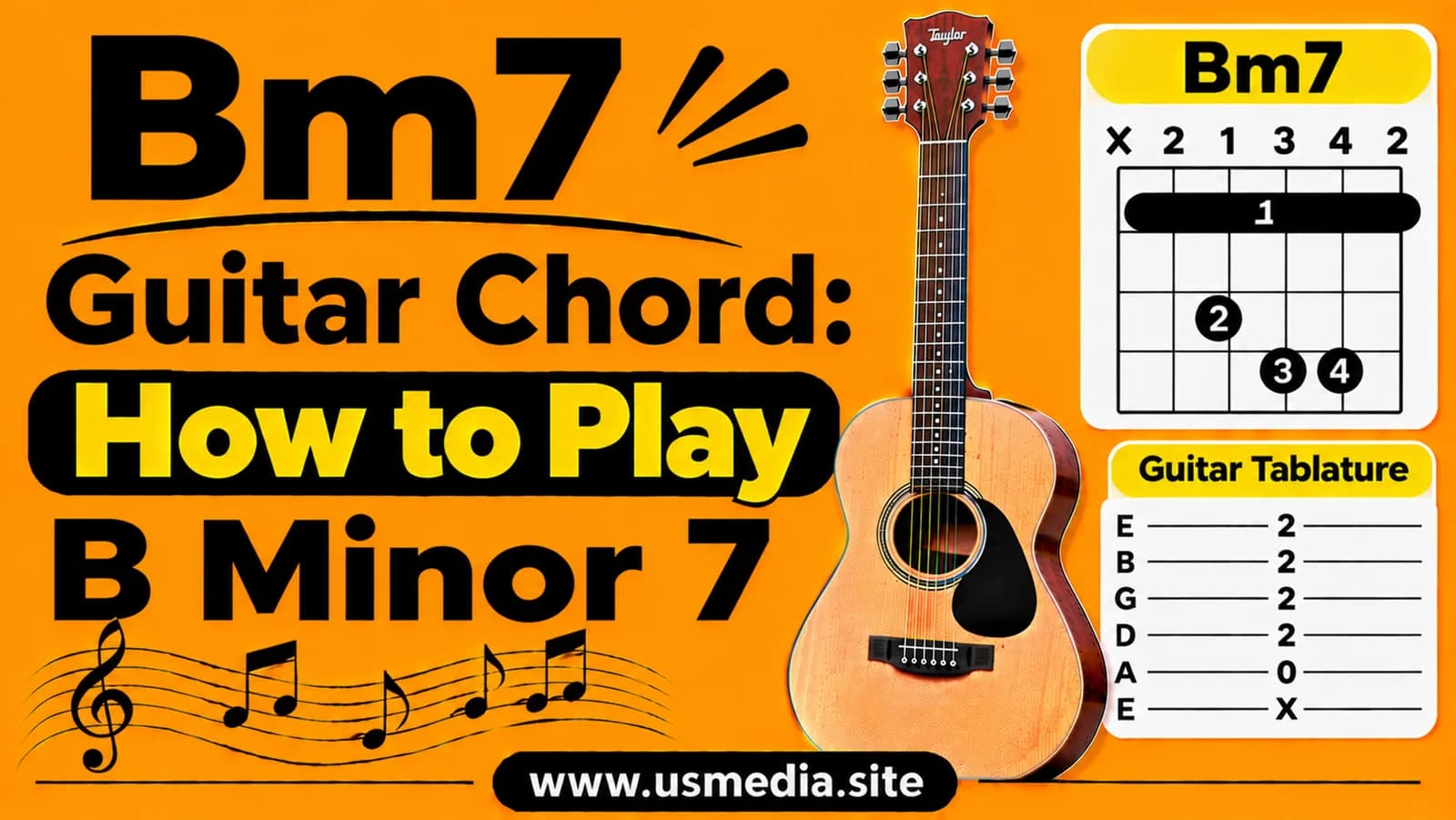
You reach a Bm7 in a song chart, but the familiar B minor barre feels slow—or one of the open strings keeps disappearing under your fingers. We’ll start with the three-finger open shape, explain the notes that give Bm7 its sound, and then compare movable forms and a practical progression. That is the approach we take to guitar lessons on usmedia.site: make the shape playable, hear what each note contributes, and put the chord to work in music.
What notes make up Bm7?
Bm7, or B minor seventh, contains four chord tones: B, D, F♯, and A. B is the root, D is the minor third, F♯ is the perfect fifth, and A is the minor seventh. The formula is 1–♭3–5–♭7.
A B minor triad is B–D–F♯. Adding A gives it the seventh-chord color. On guitar, a voicing may double some of these notes or leave one out, but a complete Bm7 voicing includes all four chord tones.
Do not read the “7” in Bm7 as a major seventh. Bm7 uses A natural. Bm(maj7), a different and less common symbol, would use A♯. B7 is different too: it has D♯ instead of D, so it is a dominant seventh chord rather than a minor seventh chord.
Play the open Bm7 chord: x20202
The open-position...